
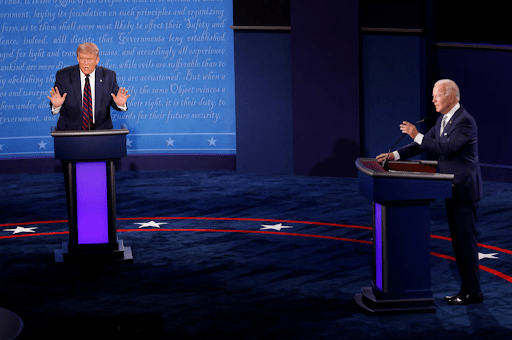
Since 1987, the nonprofit Commission on Presidential Debates (CPD) has organized the main presidential debate for every election cycle. The CPD was jointly founded by the then-chairmen of the Democratic and Republican National Committees to create a neutral territory with agreed upon rules for holding fair debates. Every four years, Americans have been able to rely on these debates for a chance to see the two candidates in action. However, following the infamous debate between Joe Biden and Donald Trump in which then-President Trump interrupted Biden 73 times, the Republican National Committee (RNC) voted unanimously in 2022 to part ways with the “biased” CPD. The RNC announced it would be pursuing “newer, better debate platforms to ensure that future nominees are not forced to go through the biased CPD in order to make their case to the American people.” With its decision, the RNC ended more than three decades of bipartisan partnership.
Unless Republicans and Democrats can create a compromise that satisfies both parties’ demands, presidential debates, an undeniably important part of the election cycle, may not be held in 2024. By subjecting candidates to important questions in front of a live audience with their opponent standing only yards away, these debates offer voters a chance to stay informed on candidates’ positions and have a sense of how each operates under pressure. Furthermore, the debates present a chance for voters to get a sense of the personalities of the leading candidates–to decide if they are the type of person they want representing their interests. Most importantly, they offer the potential for Americans to see politicians face tough questions and direct criticism outside the bubble of their otherwise tightly controlled campaigns.
The CPD has routinely provided one of the only events where a candidate has to demonstrate charisma and candor in the face of attacks, which are invaluable skills in a president. The debates allow viewers to see if the presidential frontrunners can meet these expectations and if they are, in fact, “presidential.” In 2020, more than 73 million viewers tuned in to watch the first Trump-Biden debate and another audience of 63 million tuned in to watch the rematch. While the debates might not have been what most Americans had hoped for, these high viewership numbers indicate an unquestionable interest in presidential debates.
Ultimately, the debates have a direct impact on how educated voters feel about the candidates and have a strong influence on how they cast their ballot. Polls from Pew Research indicate that 63% of voters say that the debates are at least somewhat helpful for them in making up their mind on who to vote for. Furthermore, a sizable 10% of voters say that they decided their vote while watching or just after watching the debates. In addition, polling from CBS and YouGov found that 89% of viewers of the 2020 debate felt there was a clear “winner.” While clearly not the deciding factor in swaying the majority of voters, presidential debates are a definite resource for those who are conflicted on who they will ultimately support. A move away from an organization that has long ensured regular access to candidates through debate would be a major loss for voters.
Nevertheless, a return to the CPD with its current format might not be the best course of action either. The organization had its share of controversies that led some to question the quality of their debates, including the types of questions and the rules on rebuttals. When the group was first founded, it usurped the role of the League of Women Voters Education Fund (LWVEF), the organization that had hosted the debates from 1976 to 1984.
The League was offered the opportunity to sponsor the final debate of the 1988 election but was unable to comply with the many restrictions that the CPD demanded. These demands required that campaigns be able to have control of the choice of moderators, audience composition, and press access. Effectively, the CPD created a vacuum that stifled many of the qualities that make debates valuable. Following a closed-door meeting with the CPD that left no room for negotiation, the LWVEF announced that it would no longer participate in the debates as it had “no intention of hoodwinking the American public.”
The CPD has been harshly criticized for its rule that established that a candidate must secure 15% of support in five different polls if they are to appear on the debate stage. This has routinely been an easy number to achieve for the two main political parties, the groups that founded the CPD, but difficult for third-party candidates. This stipulation was established in 2000 following the 1996 snubbing of Reform Party candidate Ross Perot who was denied the chance to debate despite receiving an impressive 19% of the vote in the previous election. Such regulations contribute to the dominance of the two major parties and often prevent important concerns from being heard.
Another issue with the current CPD format came with a 2008 rule change. Before this election rule, presidential candidates were directed to speak to the moderator and wait their turn to rebut any statement they disagreed. However, beginning with Obama v. McCain, candidates were allowed to speak to one another. This open discussion led to the crosstalk and interruptions that we see today as opposed to the restraint seen in the debates of the past. This new guideline also allowed for interjections that redirected conversation from matters of policy to issues of personality.
Ultimately, the RNC may not have any choice but to play ball with the CPD. While GOP frontrunner Donald Trump has been able to skip all four of his party’s primary debates, insiders with his campaign have expressed that getting on the debate stage with President Biden for “as many debates as possible” is an instrumental piece of Republican strategy. In addition, while the Democrats had their own issues with the CPD, neither party has made serious moves in reopening negotiations or finding a new alternative. Furthermore, even without an explicit Republican commitment to take the debate stage, the CPD has announced its locations and times for 2024 debates.
If we are indeed seeing the end of a longstanding partnership and the abandonment of the CPD, we are also seeing an opportunity to find something better. Both parties now have the opportunity to pursue a format that allows the participation of third-party voices and once again requires candidates to address the moderator rather than their opponent. These changes would improve the quality and reliability of CPD debates and help to restore and renew faith in future presidential debates.
 loupolitical.org