
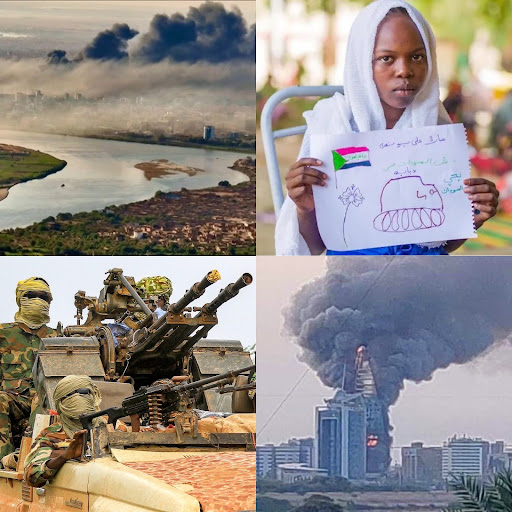
Tens of thousands of bodies litter the ground. Infrastructure lays in ruins, schools are shuttered, banks are closed, and most hospitals are rendered inoperable. Once busy streets are now empty–the millions of people who used to fill them have been displaced: forced to forge new homes in new regions and new countries. On these streets, men with guns pose deadly threats to any citizen who chooses to remain in their country. This is not Ukraine or Gaza, this is Sudan. If you cross the Sinai Peninsula and the Sahara Desert from Israel until you reach the Nile in Egypt, and follow that great source of civilization south, you will reach a beautiful country ravaged by civil war.
The warring parties are Sudan’s military, led by General Abdel Fatah al-Burhan (the country’s head of state) and the paramilitary Rapid Support Forces, led by General Mohamed Hamdan Dagalo, popularly known as “Hemedti.”. These two men seized power in Sudan in 2019, after sustained pro-democracy protests prompted them to collaborate to overthrow the genocidal dictator Omar al-Bashir, who had ruled the country with an iron fist for decades. The RSF was created by al-Bashir by legitimizing militias to eliminate threats to his rule. They committed genocidal acts in Sudan’s Darfur region in the early 2000s, killing hundreds of thousands of Sudan’s Black citizens who were protesting unfair Arab control of the country’s politics and economy centered in the capital of Khartoum.
After the fall of al-Bashir, Sudan failed to successfully transition to a democracy while the RSF grew in manpower and obtained more weapons from the United Arab Emirates. Instead, power sharing agreements between the military and the RSF were brokered that featured only limited civilian representation in government. Democratic elections were postponed time and time again due to al-Burhan’s and Hemedti’s inability or unwillingness to agree on technical issues–most importantly the unification of the military and the RSF into one fighting force, which Hemedti views as fatal to his power in Sudan. Another military coup on the transitional government took place in 2021, effectively eliminating civilian participation. Tensions between the two commanders grew over the handling of internal politics and boiled over into open civil war in April 2023.
Since then, the RSF forces have scored successive strategic victories against the military. It has taken control of much of the country’s western territory and the capital of Khartoum. There are no clear front lines in this fight though, because militias from west Sudan have allied with government forces to expel the RSF, who are responsible for the aforementioned genocide in those regions, from some positions. The RSF now seeks to push its advantage into eastern Sudan, the military’s stronghold. So far, they have faced little resistance. Political leaders in eastern Sudan have mobilized and armed tens of thousands of young men to protect their homes from RSF forces. This new phase of war threatens to rip Sudan into a failed state similar to Somalia and Libya where countless armed groups control their own stretches of the nation’s territory.

Courtesy of Sudan War Monitor. Red areas are controlled by the RSF and green areas are controlled by Sudan’s military. The Nile River meanders through Sudan’s interior.
The Human Cost
The civil war in Sudan is not a moral struggle over lofty ideals like emancipation or enslavement. It is not an ideological struggle over capitalism or communism. It is a fight between two militarized gangs for control over political power, resources, and wealth. The ever-rising cost is paid by Sudanese citizens who simply desire the prosperity nourished by democracy and peace.
In return for their greater aspirations, they have been killed. At least 12,000 people have died since the onset of conflict; some report that number could actually be as high as 50,000. For their humane hope, they have been raped. The RSF, especially, are reported to have committed countless rapes in Sudan and have been verifiably accused of selling women into forced marriages and sexual slavery. Rape as a weapon of war is nothing new to this force, and similar to past conflicts, the RSF (almost entirely comprised of Arab men) have ethnically targeted these assaults on women from Black ethnic groups. 4.2 million women are at risk of sexual violence in Sudan.
In return for their love for their country, the citizens of Sudan have been forced to leave it. Eight million people have been displaced, scattered across the sands of Sudan, across Africa, and as far as the United States. For their democratic demands, they instead get two power-hungry organizations who monopolize the nation’s resources and whose troops loot and burn the homes and businesses of the middle and upper classes. The violence has not stopped Sudan’s freedom fighters from standing by their demand for democratic reform.
The Crime of the World: An Absence of Attention
As the war drags on and the human cost rises, regional powers instigate further conflict instead of pushing both sides to negotiate. The UAE is providing military assistance to the RSF, as Egypt provides aid to the military. Negotiations organized by Saudi Arabia and the U.S. have been unfruitful and marred by disagreements between Riyadh and Washington. Proximate actors are watching a conflict that will certainly affect them unfold with detached disinterest or with consideration only of their self-interest–not realizing that a failed Sudanese state could easily become an economic and security nightmare for the entire region: northeast Africa, the horn of Africa, and the globally critical Red Sea.
The United States is preoccupied with conflicts in Ukraine and Gaza, and has effectively ignored the crisis in Sudan diplomatically. While the Secretary of State has been parading around the Middle East and North Africa attempting to salvage America’s reputation with majority-Arab nations over Israel, he has not stopped in Sudan once. What is needed in Sudan is, “a major, coordinated, high-level diplomatic effort involving the outside powers that wield the greatest influence in the region.” The United States has the power to organize this and leverage the military commanders to the negotiating table. It must. The “international media,” most of which is headquartered in the U.S., should also give the same attention to Sudan it gives to Ukraine and Gaza. The deaths of Europeans and Palestinians are not worth more than the deaths of Africans, and war is no more destructive in Europe or the Middle East than in humanity’s motherland.
Africans too. Especially those Africans that consider themselves Pan-Africanists, should be ashamed of the lack of attention given to Sudan. Pan-African scholar PLO Lumumba stated our response “is a scar on the conscience of Africa.” I have watched Africans and Pan-Africanists wholeheartedly give their attention and energy to the conflict in Israel–on both sides–while they ignore the war in Sudan. South Africa has charged Israel with genocide in the International Court of Justice, yet no such case exists for the RSF forces who are currently committing genocide against Black Africans in Sudan. I am not arguing we should not give any attention to the rest of the world, I am only saying that charity begins at home. As long as Africans have this tendency to focus on others more than themselves, the continent and the diaspora will remain impotent and disorganized.
How You Can Help the Sudanese People
Complex crises like the one in Sudan can make us feel powerless to make an impact for the people forced to live through it. While writing this piece, I was frequently moved to tears with the magnitude and the difficulty of the situation in Sudan. Nevertheless, we still have the ability to make change. Here’s how you can help:
Contact your U.S. House Representative and your Senators and urge them to support the bipartisan legislation currently introduced in both chambers of Congress. Senate Resolution 24 would urge President Biden to appoint a high-level diplomat that reports directly to the President or the Secretary of State on Sudan and it would explore sanctions against the warring parties, among other necessary, yet non-colonial steps. This method of advocacy is free of charge and would take no more than ten minutes, but it could help save countless lives.
You can also donate to organizations on the ground in Sudan who are fighting to help the people at the following links:
- United Nations Refugee Agency–Sudan conflict.
- Doctors Without Borders. These medical professionals are in Sudan offering necessary aid to injured victims. They ask for donations to be made to their general fund so that funds can be utilized flexibly to address unique circumstances on the ground.
- Save the Children. This organization gives basic necessities, medical and legal services to children affected by the Sudan conflict.
- United Nations Children Emergency Fund. This organization gives basic necessities to children affected by the Sudan conflict.
- World Food Programme. This UN-affiliated organization has fed millions of children in Sudan since the onset of the civil war.
- International Red Cross. The Red Cross is focused on supporting infrastructure destroyed by the conflict such as providing clean water and supporting health institutions.
A few dollars or a few minutes may seem like a drop in the bucket when addressing an emergency like the one in Sudan, but don’t underestimate your power to make change wherever you are. Never forget that “We are all caught up in an inescapable network of mutuality, tied in a single garment of destiny. Whatever affects one directly, affects all indirectly.”
 loupolitical.org