
The 1980s were a time of rapid growth for the American healthcare industry due in large part to the widespread application of new technologies including MRI and CAT scans. As a result of this growth, “medical issues increasingly made headlines” and legislators focused on them to a greater extent. With this increased focus, health planning groups gained more influence on legislators. The health planning movement had emerged a decade earlier out of an attempt to address the challenges faced by the changing healthcare system, including rising costs and inadequate access to care. It was in this environment of the ‘70s that some of their greatest policy victories occured, including widespread application of the Certificate of Need laws that will be the focus of this article. The movement’s goal was to promote comprehensive planning, coordination, and evaluation of healthcare services through needs assessment, resource allocation, and implementation strategies. The success of health planning initiatives were thought to have depended on collaboration and participation from government agencies, healthcare organizations, and community stakeholders.
The Health Planning Movement and How it Influenced Policy
As America’s growing healthcare sector saw increases in cost and disparities in access impacting rural populations, health planning groups found themselves at the center of the search for a solution. In the 1960s, grants were given to private groups by Congress for the purposes of health planning. These grants were intended to fund an array of goals ranging from planning actual facilities to researching how to actually do so. Eventually the movement found its concerns addressed by federal law when President Lyndon B. Johnson signed the 1966 Comprehensive Health Planning Act to “promote and assist in the extension and improvement of comprehensive health planning and public health services, to provide for a more effective use of available federal funds for such planning and services, and for other purposes.” This act was an attempt by Congress to provide incentives in the form of grants for states to work with local agencies for the purposes of health planning.
What exactly Congress intended health planning to be remains unclear. Apart from lofty rhetoric about improvements in access and quality, the bill did little but ask that state agencies and local groups work together to plan “comprehensive health plans” in their areas.
Armed with federal money, states went straight to work establishing planning agencies. These agencies, as the Act had stipulated, consisted of representatives of various groups, including physicians, local officials, and members of communities. Though the health planning movement grew out of a concern for how healthcare was implemented on the community level,the agencies’ work quickly became dominated by the interests of the healthcare providers and organizations that helped to give rise to these agencies..
It is in this environment that the proposed solution to problems of access, quality, and cost can be understood. Under the Comprehensive Health Planning Act, hospitals enjoyed greater access to government money, which was countered by rising healthcare costs in the late 60’s. In response, hospitals made a bargain: in exchange for more capital, hospitals would be subject to greater oversight.
CON Laws: Rationale and Repeal
This is the origin of Certificate of Need (CON) laws. When facing significant changes in the structure or operation of their businesses, hospitals would be subjected to the scrutiny of state regulatory boards. These boards would have the ultimate say on whether or not such changes were necessary, and thus whether they would take place. New York was home to the first CON program in 1964, two full years before the Comprehensive Health Planning Act. 28 states followed New York’s lead and implemented their own CON laws, with large hospitals being the primary proponents of the policies.
Certificate of Need policies were presented as a way to ensure high-quality healthcare at a low cost to patients.
In 1974, Congress passed the National Health Planning and Resources Development Act, which required states to enact Certificate of Need laws, lest they lose federal funding. The policy proposed that states require community hospitals to demonstrate that they were treating sufficient portions of low income patients in order to be permitted to continue operating. Under the programs outlined in the bill, certificates of need would be required not only for hospitals already in operation, but also for those wishing to establish new healthcare facilities, or even establish services within existing facilities. Within a few years, every state but Louisiana had CON laws on the books.
Such programs placed massive government and bureaucratic oversight on healthcare agencies with the goal of ensuring communities had their healthcare needs met. Ideally, a state with a Certificate of Need program in place would experience a drop in healthcare costs and increased access, with state planning boards having the final say in how services were established and allocated.
Instead, these tight regulations seem to have discouraged competition, as applying for certificates of need can be a lengthy and costly process. The amount of time and money that has got be used up to even be allowed to establish healthcare services under a CON regimen is undoubtedly prohibitive for prospective clinics and hospitals. For instance, a 2021 report by the Americans for Prosperity Foundation found that providers in Iowa seeking CONs paid an average of $15,744 in application fees, not counting fees for consultants and attorneys, and just applying does not guarantee a CON is received. As a result, the large hospitals that supported CON laws in the first place have faced less competition since they have been in place. Unsurprisingly then, the Federal Trade Commission and the U.S. Department of Justice found that CON laws are associated with increases in healthcare costs and decreases in access, spurring Congress to repeal the National Health Planning and Resources Development Act in 1986, admitting it had “failed to control healthcare costs and was insensitive to community needs.”
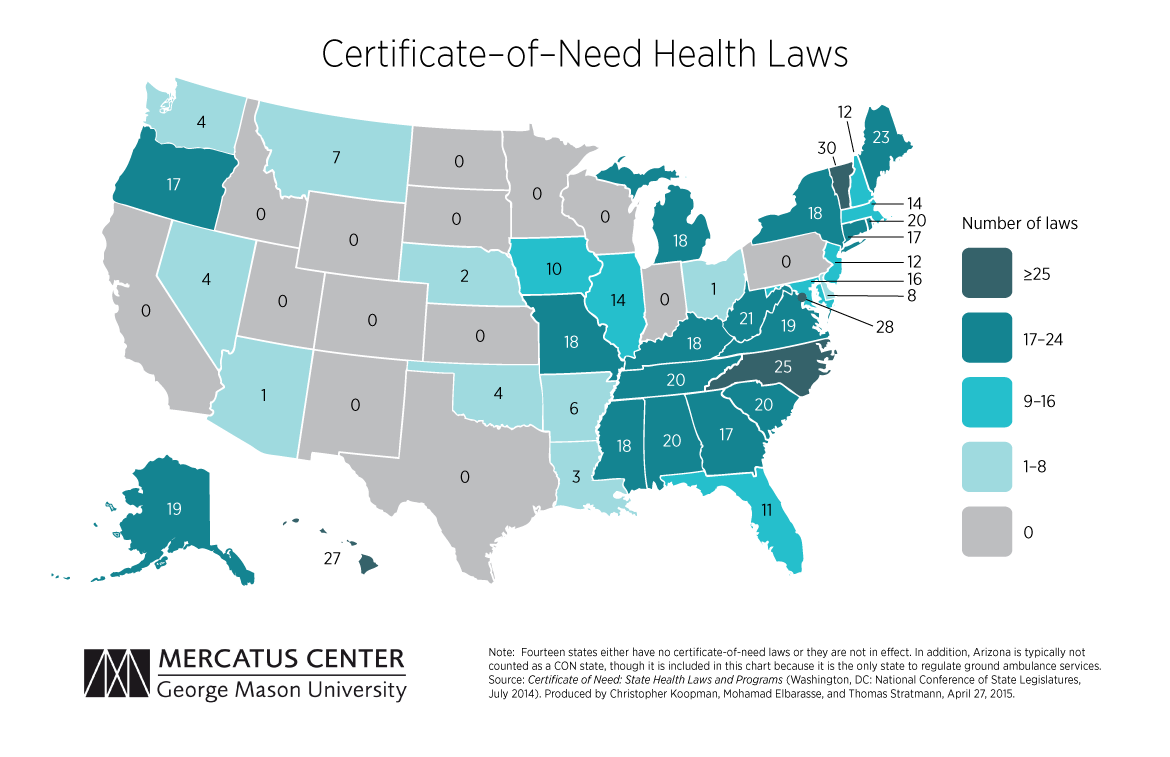
Moved by these findings and no longer bound by federal regulations, some states began to repeal their CON law. However, 35 states maintain a form of CON policies. These policies range from the regulation of a single type of facility, like nursing homes, to the regulation of nearly all healthcare businesses, like in Kentucky.
Since the repeal of the National Health Planning and Resources Development Act, the certificates of need laws have advantaged large healthcare organizations, sometimes at the expense of communities. For instance, in Northport, Florida, over 20,000 residents supported plans to build a hospital in their community of 60,000, which at the time did not have one. The certificate of need was granted by the state, but was withdrawn after appeals from other hospitals dozens of miles from the town.
In Kentucky, which regulates 18 different services using certificates of need, there has been some push to repeal the policies. In November of last year, the Supreme Court declined a case that would review Kentucky’s certificate of need law for home healthcare businesses. The case was filed by Dipendra Tiwari and Kishor Sapkota, who wanted to provide home healthcare services to other Nepali-speaking immigrants in Louisville, but were denied the certificate of need necessary to operate their business. They argued that this violated their 14th Amendment right “to earn a living.” Also in Kentucky, the Erlanger City Council voted to support the reform of Kentucky’s certificate of need policies earlier this year.
Illinois commissioned a report in 2007, in which the Lewin Group, a consulting firm with a focus on healthcare policy, analyzed data which showed, “safety-net hospitals in non-CON states with higher margins than hospitals in CON states (0.69% compared to -0.02%).” A safety-net hospital is defined differently across contexts, but generally refers to hospitals with mission statements including a goal to serve low-income populations. Oftentimes, these hospitals have a large proportion of uninsured and Medicaid patients. CON laws might be able to protect such hospitals by insulating them from competition, but as the Lewin Group report shows, these hospitals have better margins in states without CON laws. The authors of the report did, however, speculate that the CON laws could be used by safety-net hospitals to “question closures.”
These examples represent a larger push within Kentucky for review of its 18 certificate of need laws. The safety net argument seems to be one commonly proposed for the laws. After all, if safety net hospitals were protected by the laws, wouldn’t communities have greater access to healthcare?This access to care was a chief concern of the health planning movement the laws came out of. However those against the laws are prone to pointing out that they might actually reduce access to care in communities. For instance, one report estimates that CON laws result in 5,782 fewer hospital beds across the Commonwealth.
The history of certificate of need laws tells a story of community and business leaders trying to solve healthcare problems with government policies. When the policies applied didn’t work, many states got rid of them. However, some states continue to keep these policies on the book despite data that indicates they deter access and hurt margins. Further examination of these policies in states using them, such as Kentucky, would be advantageous in deciding whether or not to continue them in light of evidence mounted against them.
Conclusion
In conclusion, the rise and fall of the Health Planning Movement and the subsequent implementation of Certificate of Need (CON) laws in the United States shed light on the complex and evolving landscape of healthcare policy. The 1970s marked a period of tremendous growth in the American healthcare industry, driven by technological advancements and a growing focus on healthcare issues in the public eye.
The Health Planning Movement aimed to address the challenges of rising healthcare costs and inadequate access to care through comprehensive planning and coordination. However, the implementation of CON laws, initially presented as a means to ensure high-quality healthcare at lower costs, led to unintended consequences. These laws discouraged competition, imposed significant bureaucratic oversight, and ultimately resulted in increased costs and decreased access.
Despite their repeal at the federal level in 1986, CON laws continue to be a point of contention in various states. Some argue that these laws protect safety-net hospitals, while opponents contend that they limit the number of hospital beds and services available to patients. The ongoing debate over the efficacy and impact of CON laws reflects the dynamic nature of healthcare policy in the United States.
As healthcare systems and policies continue to evolve, it is essential to consider the lessons learned from the history of the Health Planning Movement and CON laws. Striking a balance between regulation, competition, and access to care remains a complex challenge, and policymakers must remain vigilant in their efforts to ensure that healthcare services are both high-quality and accessible to all. The story of CON laws is a testament to the need for continuous evaluation and adaptation in healthcare policy to meet the ever-changing needs of communities and patients.
 loupolitical.org